Don't be put off by my title: there is nothing sinister here chaps!! Indeed, with my general 'bloggings' I shall attempt to delight and astound you out of the mundaneness of a middle class suburban life, into the magical world of the Sophster!! Mystical...

Monday, 13 April 2020

Once Upon A Disney #15: Lady and the Tramp

The golden age continues this week with the adorable, if slightly traumatic and racist...


Lady and the Tramp (1955)


Lockdown, week 5 - Feeling cosy

Previous Disney films have already shown us that the studio is very fond of their canine pals, but this one cements it. Following a typical 1950s opening (painted concept art with a swooning choir singing 'Bella Notte'), we are told that this movie is dedicated to dogs. And immediately, I'm sold.

Zooming into a nostalgic scene of snow-covered houses in 1909, we are introduced to Lady, a gift for a wealthy new wife on Christmas Day. Thankfully, this puppy isn't just for Christmas, because she is RIDICULOUSLY cute. A wide-eyed, loveable spaniel, the animators have found the key to our hearts. As Lady scrambles to win a place on her owners' bed – Jim Dear and Darling, as we know them through her ears – her movements are uncanny for a real-life dog. Being fairly closely acquainted with a cockapoo, I know all too well the whining at the door, and the excitable tail wagging when said door is opened. She's just precious.

The gift to end all gifts


Just as well-observed as Lady is her dependable doggy neighbours, Jock the Scotty dog, and Trusty the bloodhound, with no sense of smell. Soon we start to develop a sense of canine community, with the whole film shot as a dog's eye level. We rarely see past human waists, and everything the owners talk about is interpreting through the innocence of a pooch.

With this in mind, Lady is understandably concerned when she starts being ignored, and Jock figures out that her owner Darling is pregnant.  For a dog, this means the potential to get shut out, and for a spaniel, sacrificing undivided attention. Enter troublemaker, the Tramp. Full of Sky Masterson charm, he adds fuel to the fire, telling her that her owners will have no time for her once the baby arrives. However, Tramp proves his position as loveable rogue when the doggy poop hits the fan.

'Get out of my pub'


As if she's not troubled enough, things go from bad to worse for Lady – much worse. After discovering that Jim Dear and Darling still love her even after the baby is born, Lady is content. But then her beloved owners go away for the weekend and Aunt Sarah really f-s it up. Firstly, she clearly hates dogs and won't let Lady near the baby. Not cool. Secondly, her Siamese cats are evil personified. Perhaps on a par with Cinderella's Lucifer, they destroy the house, blame it on Lady (which gets her muzzled!) and try to eat the goldfish all in the space of 5 minutes. Oh, and sing an extremely racist song, but I suppose that's not their fault. One thing's for sure – Disney is not a cat-lover.

'We'll never get our deposit back!'


Lady's dash for freedom from the muzzling causes her path to cross with Tramp once again. Now in dire need of a helping hand, Tramp uses his resourcefulness to help her out, charming the spaniel along the way. After tricking a beaver to nibble her muzzle clean off ('It works shhhwell!') the pair head for Tony's, where their romantic Italian date goes down in Disney history. While real dogs would growl at each other to try and swipe that last meatball, we'll forgive the storytellers for using dramatic license here. The 'Bella Notte' montage, where the new couple takes a moonlit stroll through the park, draped in muted blues, is genuinely pretty romantic. It helps that the entire town looks like Mainstreet USA in Disneyland, with pretty shopfronts and turn-of-the-century architecture.

Find yourself someone who looks at you like this mongrel looks at a spaniel <3


But of course, Tramp ruins it and gets Lady into trouble again – the scoundrel. Thrown into the Pound, Lady is distraught and heartbroken. The perfect time for sultry Pekingese Peg to let her know that Tramp is a player, through the medium of a jazz number. 'He's A Tramp,' accompanied by a howling barbershop quartet, is signature Peggy Lee, and wouldn't be out of place in a human musical of the time. We're thinking Guys and Dolls, White Christmas style.

When you go a bit too heavy on Bank Holiday weekend 


It takes something even more sinister than the shockingly racist Si and Am to give Tramp the opportunity to redeem himself. A massive, terrifying rat. Having seen Lady chase this evil bastard off the backyard earlier in the film, he's back – and for some reason, he wants to attack the baby?! So dark. When Lady and the Tramp infiltrate the nursery to protect the newborn, Aunt Sarah thinks they are the danger, and sends Tramp to the Pound.

Thankfully Jim Dear and Darling arrive home just in time and set things straight, but not before Jock and Trusty chase after the dogcatcher's wagon to rescue Tramp. In heroic fashion, Trusty tracks him down, but gets crushed under a wheel in the process. Honestly, this was an emotional rollercoaster. Following some genuine trauma, Lady and the Tramp delivers the perfect happily ever after, with Trusty on the mend, and new puppies in the neighbourhood. Boxes ticked.

Our faces when we saw this biological inaccuracy 


Best Song: 'He's A Tramp' because Peggy Lee. And the howling dog backing singers.

Disney Detail: The film is also set in Walt Disney's favourite time period, the 1900s, on which he based large sections of his Disney parks. He saw it as a nostalgic yet optimistic time. Peggy Lee voices not just Peg, but Si and Am, and Darling. Finally, no-one knows whose initials J.M and E.B are, written in a heart in cement during Lady and the Tramp's date.

Why it's a Classic: It gave us that iconic spaghetti scene.

Sunday, 5 April 2020

Once Upon A Disney #14: Peter Pan

From Wonderland to Never Land, it's time to take flight and journey to one of Disney's most magical movies...


Peter Pan (1953)


That's right, Disney's return to form isn't reverting back to the Three Caballeros days for a good while yet. The studio's retelling of J. M. Barrie's beloved children's book might take a few liberties with the story, but it delivers on heartwarming fairytale goodness.

Me when someone says there's cake in the kitchen


Opening with the swoon-worthy song 'The Second Star to the Right,' we're greeted with pretty artwork showcasing the tale to be told, with images of pirate ships, mermaids, and more. Followed by a dreamy aerial shot over London in the twilight, we know we're in for a treat.

After being introduced to the Darling family, including Wendy, John, the adorable baby Michael, and –most importantly – Nana the dog – the familiar Peter Pan theme is initiated. Mr. Darling has no time for childish fantasies-thank-you-very-much, and, while in a comical rage, decides that it's time for Wendy to grow up and leave the nursery. The perfect cue for our pointy-capped hero to enter the scene.

'I made this outfit myself from leaves... well I like it.'


Peter Pan's entrance into the Darling household and subsequent journey to Never Land is one of the most well-crafted, memorable scenes in Disney's back-catalogue. After chasing his shadow around the nursery (showing off the animator's clever use of light and dark), Wendy helps him to sew it back on – while the resentful Tinker Bell looks on. Tinker Bell is a whole mood on her own, and her signature trail of pixie dust is all that's needed to convey that magical, childlike excitement of going to Disneyland for the first time.

By the time 'You Can Fly' begins, we are fully immersed in the escapist fantasy that Walt Disney intends his audiences to enjoy. The image of Peter, Tinker Bell, and the Darling children flying past Big Ben is a gorgeous, glittering spectacle, with the soaring score helping us lift off into a living storybook.

Not pictured: extreme motion sickness


Unfortunately for romantics, but in good news for schoolboys, the spell that Peter Pan casts over Wendy and the rest of us in whisking her away to Never Land soon crashes and falls, as he turns out to be a precocious douchebag. He has a major hero complex, assuming that everyone will bow to his every whim and he'll always get his way. Despite his obvious character flaws, Tinker Bell is literally out to murder Wendy with jealous rage for Peter showing her any attention at all. In fact, the portrayal of women is one of the film's main problems, making out that female friendships are impossible and every girl – and mermaid – in Never Land is obsessed with Peter. For whoever needs to hear it – you can do better, babe.

One pissed off pixie


However, despite the less-than-feminist moments and the obvious racist issues around the 'Red Injuns' (Tiger Lily, a love interest, is far paler than her tribal counterparts) there is a lot to be commended in Peter Pan. One of which is – of course – Captain Hook. The perfect pantomime villain, complete with sidekick Smee, Hook is both sinister and silly, laying the groundwork for future iconic Disney villains like Scar and Hades. The set pieces with Hook and the crocodile are genuinely funny, while you feel a real sense of threat when he and Peter come hand to hook. Not to mention his impeccable dress coat and luscious locks.

When someone suggests using their 'daily exercise' allowance to actually go for a run


As dawn slowly turns to dusk in Never Land – signified by the animators' very clever use of colour and shadow throughout – it's time to go home. Along the way, characters have learned from their mistakes (Tinker Bell understanding that Wendy will never replace her and coming to her aid), discovered what it means to have a mother (thanks to Wendy's adorable storytime with the Lost Boys),  and realised that you can never double-cross a crocodile (enough said). Peter is still a nob, but at least he goes home.

As the glittering golden pirate ship cruises back through the sky towards London, you have a sense that you just awoke from Wendy's pleasant, if dangerous, dream – in contrast to Alice's dystopian nightmare last week. Not a bad way to spend 90 minutes of an evening.

Chills. 


Best Song: 'You Can Fly' for backing up one of Disney's most dreamy, magical moments

Disney Detail: This is the first of Disney's signature crocodiles (yes, there are a few of them over the years). The design of the iconic crocodile in Peter Pan who has a taste for Captain Hook is referenced again in other movies like Robin Hood, The Rescuers, and The Sword in the Stone.

Why it's a Classic: It captures the same magical, cozy nostalgia as Disney very early movies like Pinocchio and Snow White, while being firmly planted in the 1950s. A pixie-dust-fulled fairytale with the perfect blend of adventure, romance, and childish innocence. And, of course, it brought us Tinker Bell, who is about as synonymous with the studio as Mickey Mouse himself.

Still can't forgive them for leaving Nana behind, tbh.


Saturday, 28 March 2020

Once Upon A Disney #13: Alice in Wonderland

Hi diddly ho Disney aficionados!

Well, quarantine has hit and we're all looking for silver-linings – mine is the arrival of Disney+ in the UK, and the likely possibility of consuming many more magical movies in the coming weeks. We're already starting to go a little stir-crazy around the world, so what better film to fall down the Disney rabbit hole with than...

Alice in Wonderland (1951) 


Bye bye sanity 


For some reason which I'll never quite grasp, this was one of my all-time favorites as a child. As in, I was 'wear-out-theVHS-with-multiple-viewings' obsessed. I suppose the bright colours and meandering plot work together to entertain a five-year-old who doesn't quite understand the frightening existential questions Lewis Carroll's disturbing tale provokes. 

Disney's spin on Carroll's classic is surprisingly weird through today's lens – but I suppose when we compare it to previous flicks like Fun and Fancy Free (ft. those ventriloquist dummies) and the abstract sequences in Fantasia,  Alice's adventures are just as sane as can be expected in the 1950s. 

'Umm, ya boring.' 


I won't delve into plot details as we're all familiar with the basics, but I will say one thing – Disney leaves no stone(r) unturned. In fact, the film feels so full of Carrollian content (it's a word now) that it barely holds itself together. The 75 minute runtime is broken up into at least 13 topsy turvy parts, full of riddles, songs, fantastical creatures, and general anxiety-inducing action. 

Curioser still, there is not one likeable character in the film. Alice herself, while the victim for the most part, is a self-proclaimed brat, doling out pompous advice that she seldom takes (she even sings a whole self-pitying song about that). The white rabbit is infuriatingly skittish, the Mad Hatter and March Hare are downright rude, the Cheshire Cat just loves the drama, the Caterpillar has not got time for anyone – and let's not even delve into what the walrus did to those poor oysters

When someone tries to drag me up to the dance floor for 'Cotton Eyed Joe.'


However, the constant twists and turns, double-crossings, and the sinister atmosphere is a large part of how Alice in Wonderland keeps timeless appeal. Watching this for the first time as an adult, I found that I had a morbid fascination with what terrible thing might happen next, right down to the Queen of Hearts threatening to chop off our protagonist's head. 

Amid frustration at the illogical, nonsense narrative, we also have time to admire the stunning modernist art style that makes Disney's Wonderland so magnetic. Mary Blair's designs and direction lean into the psychedelic appeal of Lewis Carroll's novel, and the sense of scale is conveyed flawlessly to envelop us in this over-exposed and confusing world. Unlike Tim Burton's later version which leans too heavily on complicated CGI to distract from the story, this earlier, stylised approach is the perfect fit. It's both unmistakably Disney, and unquestionably Alice. 

Trolololol


I don't know if I'll watch Alice in Wonderland again in a hurry but can say that I admire the boldness of this adaptation – and it will haunt my dreams for a while.  

Villain rating(s): Basically every character is a villain in this movie, but let's do this by the book and call on the Queen of Hearts, who's a solid 8/10. Yes, she's pretty two dimensional, but her hobbies of animal abuse and chopping heads are pretty intense.

When I spot someone hoarding toilet roll


Best Song: 'All in the Golden Afternoon,' sung by the snooty flowers, for being a rare peaceful moment in an otherwise tumultuous adventure

Disney Detail: Mary Blair's iconic designs and art direction for the film has served as a clear inspiration for the Disney parks, especially Disneyland Paris, where the bold, colourful props are perfect for creating a fantasy world.

Why it's a Classic: Already based on a classic novel, this adaptation manages to feel intrinsically 'Disney,' whilst leaning into Lewis Carrolls' strange, uncomfortable fever-dream of a story.

Sunday, 8 March 2020

Once Upon A Disney #12: Cinderella

Your eyes aren't deceiving you – here's a Disney film you've actually heard of! Rejoice!

We've hit 1950, which you'll be pleased to hear is much less painful than the previous decade. We've got some legit classics ahead of us, kicking off with a quintessential Disney princess' perfect fairytale...

Casting off the stench of 'Fun and Fancy Free'


Cinderella (1950) 

A choir croons the title song 'Cinderella' whilst an old-fashioned fairytale book opens to reveal a glittering castle. We all collectively breathe a sigh of relief. This is more like it. Indeed, the opening to Disney's second princess film might be the most stereotypically 'Disney' there is.

Following the narrator's preamble, which explains the dead dad, the stepmother gone bad, the kingdom's single prince, and Cinderella's servant-state, we get down to business. Cinders awakens from her dream-filled slumber, summoning all her animal friends, including cute bluebirds and talking mice, who are perfectly trained in housework. Cue the first proper song.

'I just had that dream that all my teeth fell out. Thank f**k I'm awake.'


'A Dream is A Wish Your Heart Makes' has arguably become more popular after Lily James' rendition in the live-action remake, but it's stood the test of time as one of the better Disney princess songs. Unlike Snow White or Aurora, Ilene Woods' vocals aren't childish or operatic, but smooth and sweet, mirroring jazz singers of the time. They also fit the character herself – while she's forced to submit to her stepmother and stepsisters, Cinderella is quietly rebellious, slyly ridiculing them to her animal friends and never forgetting that she should have it so much better.

The first half of the film relies heavily on Cinderella's relationship with the creatures of the house. Most scenes centre around the mice (Jaq, and new recruit Gus), as they bond with Cinders – they can talk in a squeaky kind of way – and try to avoid the menacing claws of Lady Tremaine's cat, Lucifer.

'FEED ME YOUR SOUL, PETTY HUMAN.'


Lucifer is basically the devil. The literal cat-and-mouse scenes, where the furry fiend is trying to catch his prey, Tom and Jerry style, are ridiculously tense. I was actually holding my breath and yelping at the screen for the mice to get away from his lethal grip. His part in the film's climax is extraordinarily vile, and I'm glad to see the back of him.

Less openly violent but even more sinister than Lucifer is his owner, the formidable Lady Tremaine. Just like her feline counterpart, the vindictive stepmother is introduced to us by a pair of eyes glowing in the dark. Indeed, she is synonymous with darkness, literally throwing shade on to Cinderella wherever she goes. The true power of her menace lies in restraint – while she goads the stepsisters into getting their claws into Cinderella and leaving her in tatters, she simply smirks from the sidelines. Unlike other Disney villains, she has no magical powers, but plays in mind-games. The idea that she could be real makes her even more scary.

Opening your email inbox after a holiday 


In a film that plays very cleverly with darkness and light, the bouncing Fairy Godmother arrives in all her bright, sparkly glory, as a desperately needed beacon of hope. 'Bibbidi-Bobbidi-Boo' has become a stone-cold classic, and not just for its earworm quality. It's a tonic to the desperate sadness in that moment, and sets the story on a trail to happiness.

As well as being a well-crafted story with real pathos in its characters, Disney's 12th animated classic oozes style from beginning to end. From the smooth, '50s lilt of its songs and Cinderella's voice, to the colour palette. The palace itself is a designer's dream, the reflective blue and purple glittering surfaces calling back to Cinder's famous scrubbing scene where she harmonises in her own soap bubbles, and reaching forward to the elegant glass slipper which unlocks her freedom and happily ever after.

Me vs. any decent property in St. Albans


Cinderella marks a true return to form, with a perfectly paced story, memorable songs, proper villains, cute sidekicks, and a character you can truly get behind. Bring on the rest of the 1950s.

Villain rating(s): 10/10 for Lucifer, who does nothing to make me into a cat person (pure evil). 9/10 for Lady Tremaine, who really needs a good slap around the face to get rid of that smirk.

Best Song: 'A Dream is a Wish Your Heart Makes' (and the mouse reprise) 💖

Disney Detail: Many of Cinderella's tropes are synonymous with Disney Princess movies, but a couple of details are knowingly nodded to in 2007's Enchanted. One is Giselle's opening song where birds and mice are helping her make a dress, another is her reflection in the bubbles during 'Happy Working Song,' and the third is love interest Nancy Tremaine – played by the incomparable Disney legend Idina Menzel – being named after Cinderella's stepfamily. Luckily, she turned out not to be evil at all.

Why it's a Classic: Cinderella brings together the traditional fairy tale format that Walt Disney Studios are famous for, whilst incorporating contemporary style and flair in the animation. Cinderella herself, as well as the Fairy Godmother, are synonymous with Disney magic.  

Sunday, 2 February 2020

Once Upon A Disney #11: The Adventures of Ichabod and Mr. Toad

It may have taken about four months longer than I imagined, but we've hit the last Disney animated film of the 1940s – thank sweet baby Jesus. While this week's film isn't a stone-cold classic, at least we have no pervy Donald Duck or creepy dummies. Instead, we get two somewhat familiar tales, with...

The Adventures of Ichabod and Mr. Toad (1949)


A candidate for the longest title in the challenge, this film retells one British and one American tale – a toad-centric version of Kenneth Grahame's The Wind in the Willows, followed by Washington Irving's The Legend of Sleepy Hollow. Why it's not called 'The Adventures of Mr. Toad and Ichabod' we'll never know. 

Baby Toady, Baby Toady, Riding on a horse, Baby Toady (OOH OOH)

Firstly, to Mr. Toad. Narrated by Sherlock Holmes actor Basil Rathbone, this is a largely accurate retelling of Grahame's classic, leaning heavily on toad's antics and replacing some humans with animals, and vice versa. In true Disney style, an elaborately decorated book opens, taking us into the world of Wind in the Willows.

The tale is traditionally told, with all the familiar characters – Mole, Ratty (who looks like a typical Disney rodent ala The Rescuers), Badger (who has a very dodgy Scottish accent), and – of course – Mr. J. Thaddeus Toad himself. Joining the story is his horsey friend and general mischief-maker Cyril Proudbottom.

'I've had this Argos tree for 10 years!' 


As in the original tale, Mr. Toad ricochets from one sticky situation to another, driven by his fickle nature and greed – and a song or two. However, instead of being the primary cause of his own downfall (stealing a car and getting thrown into jail), he is much more victim in this version. He's hoodwinked by the ridiculously named Mr. Winkie, a sly barman who persuades Toad to trade his estate for a motorcar, not disclosing that it is stolen.

Never trust a dude with no bottom teeth


After rollicking along for about half an hour, the climax of this first section is an impressive setpiece. Having escaped from prison to find Toad Hall overrun by weasels, Toad and his friends hatch a plan to claim back his home, which results in a chaotic but well-engineered fight scene, full of slapstick and tension. Think of the scene in Beauty and the Beast when the household items drive out Gaston and his gang, and you're along the right lines.

All in all, Mr. Toad's adventure was a pretty entertaining way to pass the time, and I wouldn't mind watching it again.

Sometimes you can judge a man by his horse

The second tale takes a sinister turn – but not as much as you'd think. Far from the version of Sleepy Hollow I'm familiar with (the Tim Burton masterpiece) Disney's adaptation is much closer to the original folk tale, centering on schoolmaster Ichabod Crane's attempted romantic conquest, with only a little bit of headlessness right at the end.

Narrated by the ever-smooth Bing Crosby, Ichabod's story is a swing-infused romp around the famous gothic village, as our protagonist woos Tinkerbell Katrina Van Tassel. Despite his unfortunate looks – his nose is quite literally 'stuck in a book' – he is full to the brim with charm and a crooning singing voice, thanks to Crosby's voice acting.

A far cry from Johnny Depp


It's only in the story's third act that the spookiness seeps in. At the Van Tassel party, Katrina's other potential suitor, the Gaston-like Brom Bones, gets fed up of dancing with the crazy fat chick (bless her) and decides to tell the story of the Headless Horseman of Sleepy Hollow. Intended to drive his competitor away, he gets all the party guests to join in his joyously macabre rendition of 'Headless Horseman,' a Blues-inflected number, again performed by our man Bing.

The song does its job and lo-and-behold, Ichabod is chased out of town by the Headless Horseman, never to be seen again. Or so it's been told. Whilst I probably enjoyed the Mr. Toad section better, this is a decent, zippy retelling of a classic folktale, which watches a bit like a jazzy Beauty and the Beast with a Halloween vibe.

He is CARRYING A HUMAN WOMAN


And that's the 1940s DONE. Time for a good old string of classics until we hit the patchy 2000s (unless, of course, you're a closet Home on the Range fan).

Villain rating(s): 7/10 for Mr. Winkie, who, despite his name sounding like a Teletubby, is much more devious (but probably less creepy).

Best Song: 'Headless Horseman' is a BOP

Disney Detail: The Mr. Toad portion of the story inspired 'Mr. Toad's Wild Ride' at Disneyland California, where you ride in a motorcar, and the Toad Hall Restaurant at Disneyland Paris (where you can get fish and chips because Britain).

Why it's a Classic: It tells two well-loved stories with passable accuracy, and a dash of Disney magic thrown in. The storytelling techniques start to revert back to the OG classics, showing that the studio can still tell well-paced, long-form stories with catchy songs.

Monday, 20 January 2020

Once Upon A Disney #10: Melody Time

It might have taken 7 months, but – we finally made it to double figures, lads! 

If your patience for musical compilation films is wearing thin, you only have one more to endure, and that is... 

Melody Time (1948)


We're almost at the end of the 1940s, but there is always time for a little melody (or 6). Indeed, Melody Time picks up where Make Mine Music left off, showcasing popular artists of the age alongside some charming – and some slightly weird – animated sequences. 

Beginning with the pleasantly jazzy titular refrain 'Make Mine Music,' we're taken on a magical journey which pitstops at ice-skating bunnies, angelic farmers, an anthropomorphic boat, cowboys, and – gulp – the Three Caballeros. Oh yes, Donald the creep is back. 

Name a stranger collection of characters. I'll wait.

The animated variety show kicks off with 'Once Upon A Wintertime,' a sequence in which a rabbit couple mirrors a human couple as they frolic on the ice, the woman gets moody and falls in, and the man inevitably rescues her. Oh, Hollywood. However, casual sexism aside, it's a sweet musical number, and conveys a romantic little tale in colourful Disney style. 

Following a short interlude section 'Bumble Boogie,' where a bee has to escape from some musical notes against a swing-style version of 'Flight of the Bumblebee,' we zip into the next main story – 'The Legend of Johnny Appleseed.'

Before Gaston started his egg-eating regimen

Following the fabled life of turn-of-the-century American pioneer and tree-planter John Chapman, this section is the definition of Christian wholesomeness. The basic plot: a humble apple-tree farmer wants to go on an adventure with the pioneers, but doesn't know what he'd be useful for. An angel visits him and encourages him to roam the country planting apple trees, and voila – his life's purpose is complete. When he eventually dies after years of appley service, the angel returns to tell him he's needed in Heaven, as they're short on apples. 

Yes, that's it. However, this section is a lot more than the sum of its parts – the simplicity of the story allows for messages of kindness and tolerance (a rarity thus far in some of the previous, violent shorts), a surprising meditation on mortality, and an illustrative animation style that feels like a pretty children's book is being read to you by a loved one. It's just a bit heartwarming, really. 

Enter the Andrews Sisters, last heard in Make Mine Music, narrating the love story of a bonnet and a top hat. This time, a cheeky boat child called 'Little Toot' – who is unreasonably adorable – is up to no good and has to grow up and prove himself if he's going to win the respect of his family (his dad is also a boat). 

Can you adopt a boat? 


Of course, he's given the chance to weather stormy seas and become the hero, which is lovely. Musically, this is by far the catchiest tune so far, with the Andrews' faultlessly blending vocals narrating the entire story in rhyme. We'll ignore the fact that this is essentially an American rehash of 'Pedro' the plane tale from Saludos Amigos

After another nature-themed interlude – this time a sparkling, gorgeously animated tribute to Trees (creatively called 'Trees') – we're on the home straight. I'm sorry, I can't avoid it any longer. It's Samba time *shivers*.

Honestly. LEAVE HER ALONE.


Luckily, our final visit from Donald and José the parrot – at least I hope they won't make an appearance in a future film – is fairly inoffensive. Treading the same Latin boards as previous outings, the feathered friends reunite with the Aracuan Bird of The Three Caballeros fame, in a section fittingly entitled 'Blame it on the Samba.' Oh samba, you are to blame for so much. With the obligatory real-life woman dancing and playing an instrument, the birds sort of dance around her legs a little and then we're let off the hook. Phew. 

The finale takes a leaf out of Fun and Fancy Free's book – minus the inherent creepiness – and is framed by IRL actors spinning a yarn for a captive audience of kids. This time there's a boy AND a girl, they seem like they might actually be related to the adults, and there is no ventriloquist dummy. But there is a Western, Calamity Jane aesthetic. So far, so good.  

That's a bounce she'll regret


'Pecos Bill' is supposed to answer a little boy's question – 'Why do Coyotes howl at night?' It gives the most convoluted answer you could imagine, involving a feral child raised by Coyotes who becomes a gun-toting cowboy, lusts after a woman, gets married, and then loses her when she is propelled into outer space by bouncing on her bustle (i.e. butt). No word of a lie. Old Bill is so sad at this turn of events that he turns back to his Coyote ways and howls in grief for his lost love every night. 

... Anyway, 'Pecos Bill' aside, Melody Time is probably the most successful Disney compilation movie of the '40s. Each section looks nice visually, tells a succinct story, and the movie as, a whole, clips along at a manageable pace. But I cannot wait for a return to form soon. 

Villain Rating: 4/10 - That bustle has a lot to answer for 

Best Song: 'Little Toot,' cos he's so cute (see, I even rhymed!) 

Disney Detail: Aside from the references I already mentioned, Melody Time has just as much right as every other 1940s Disney animation to act as a musical time capsule of where the studio was at the time, warts and all. 

Why it's a Classic: It shows that Disney has learned something in the last decade. While it doesn't reach the dizzying heights of Fantasia, it's a definite improvement on Make Mine Music, and Fun and Fancy Free, in both animation quality and tone.

Sunday, 12 January 2020

Once Upon A Disney #9: Fun and Fancy Free

Happy New Year Disney aficionados. I hope you had a magical, Zip-a-Dee-Doo-Dah time (yeah, that's right, I made a Song of the South reference, and I'm not even sorry. This is 2020 Soph).  


Well, what started as a weekly challenge hasn't quite gone according to plan, but as my new year's resolution is fast becoming... better late than never! There are only 2 more weeks of weird films to go, and seeing as January is pretty much a write-off month anyway, let's get these duffers done as soon as possible. 

Seeing as I watched this film literally MONTHS ago and I'm keen to crack on, this may be a particularly short post. Let's see what I can remember of... 


Fun and Fancy Free (1947)


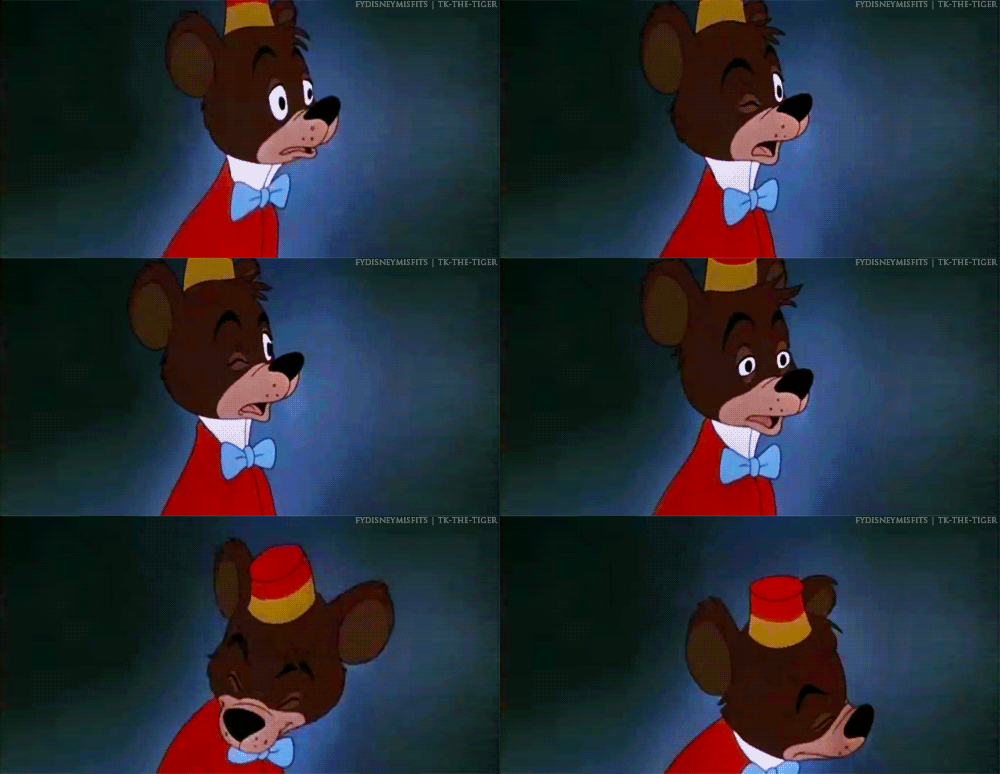
I'll let the cat out of the bag – this is a film of two halves. There's the cute, fairly fun and fancy-free part, involving bears, chipmunks and jolly music. And then there's the genuinely terrifying half including real-life ventriloquist dummies and a possible paedo. 

The film opens with Jiminy Cricket singing a jazzy little opening number, and even includes a cameo from Cleo the fish from Pinocchio. Could we finally be in safe hands after weeks of creepy Donald Duck and singing hats? You might think so. After Jiminy draws attention to the startingly familiar problems making headlines in the1940s (Extinction and Global Warming), he decides it's time for some escapism. 

In this frame of mind, Jiminy introduces the first story of the film – 'Bongo'. Following the escapades of a circus bear who makes a break for it to reconnect with his natural roots, the section uses story-telling techniques from a variety of previous Disney movies. 

So far, so BEARable

First, we get the pastoral 'scene-setting' akin to Bambi, with cute forest animals weathering a storm to the backdrop of crooning vocals. Secondly, we follow Bongo the bear's exploited life in the circus (Dumbo immediately springs to mind). When Bongo breaks free and falls in love with a lady bear in the forest, we start to get 'Bambi and Thumper's inappropriately sexual longing for women' vibes. This soon descends into the gratuitous violence carried forward from more recent compilation movies like Make Mine Music, when Bongo has to fight off a competitor and then the bear's mating ritual turns out to be... slapping each other?! It's all a bit of a mess, but it's nothing compared to what's to come. 

Me after watching this film


The second half of the movie takes a decidedly tone-deaf turn, via the creepiest kid's birthday party in the history of Hollywood (and that's saying something). Jiminy gets invited to a large, conspicuously parent-less house, where a little girl in inexplicably celebrating her name-day with 'ventriloquist' and 'comedian' Edgar Bergen. I use inverted commas because he is terrible at both of these skills. Poorly handled by him are Charlie McCarthy and Mortimer Snerd, his terrifying puppets. The former looks exactly like the creepy dummies in Goosebumps, the latter looks as if his face has half melted off. 

I would not be able to sleep after this 'story time' 


Assuming we consider this whole set up as somehow normal, Edgar launches into telling the story of 'Mickey and the Beanstalk,' with frequent and painfully unfunny interjections from Charlie the Creep (as we will now call him) throughout. The story goes pretty much according to tradition – i.e. Mickey sows the magic beans, climbs the beanstalk, defeats the giant etc – but, like every other film he rears his quacky head in, Donald is an absolute menace. This time, rather than just being lechy, he's an axe wielding maniac. Of course, once Edgar has concluded his poorly narrated story, it's alls well that ends well, and – providing the little girl's parents come home at some point – there's no harm done. 

Mum: Delirious Donald Duck can't hurt you
Delirious Donald Duck: ... 


All in all, Fun and Fancy Free starts promisingly but will leave you stunned, a little afraid, and ultimately wishing you could get that 73 minutes of your life back. But you win some, you lose some I suppose.  

Villain Rating: 10/10 for Charlie the Creep, who is pure nightmare fuel

Best Song: "I'm a Happy-Go-Lucky Fellow" (sung by Jiminy Cricket at the beginning, when there's still hope) 


Disney Detail: From what I can remember, the chipmunks at the beginning of the 'Bongo' section seem to be an early version of the Chip N' Dale designs. Also, that whole segment calls back to the circus storyline in Dumbo

Why it's a Classic: The inclusion of Jiminy Cricket and Mickey Mouse don't do this film any favours, as they just remind you of better films that contained those characters (Pinocchio and Fantasia, respectively). However, the music is nice as always, and there are some cute, on-brand moments in the first half.